Ask a teacher what they use for quick checks and you will usually hear a platform name, not a hardware name. Then ask what happens when the access point is saturated, or when the building goes phone-free, or when a 1:1 cart comes back with nine dead Chromebooks. That is the seam this comparison lives in. Game-based quiz platforms are excellent at what they do and helpless without devices and bandwidth. A clicker kit is the opposite.
The one-line answer: use the QOMO QClick QRF300 (from $687.88 for a 12-remote kit to $1,588.88 for 32) when the activity must run regardless of devices, network, or phone policy, since it is a one-time purchase at roughly $50 to $57 per seat with no accounts and no subscription. Use Kahoot when the room already has a device per student and you want its game show format, with school and district plans commonly listed around $15 per teacher per month for standard tiers and $25 for pro tiers on annual billing. Use Quizizz, now branded Wayground, when self-paced homework-style practice matters more than a live shared screen, with an individual teacher plan reported around $144 per year and school pricing quoted per campus. Many buildings end up with both: a subscription for connected classrooms, and a clicker kit for the rooms and the days where connectivity is not a given.
Read More
| Tool / Business / Provider | Score | Speed / Distance | Pricing / Details | Rating |
|---|---|---|---|---|
| Top Choice | Works offline | From $687.88 (12-seat kit) | ★★★★★ | |
| Instant setup | Free tier; school plans commonly listed near $15-$25 per teacher/month | ★★★★☆ | ||
| Self-paced friendly | Free tier; individual plan reported near $144/year | ★★★★☆ |
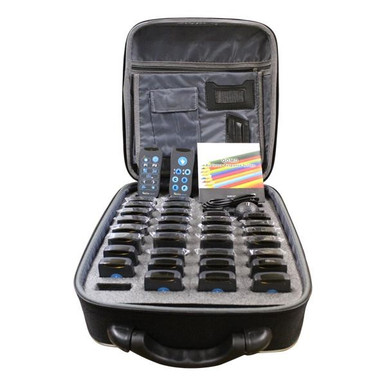
The QRF300 wins this comparison on availability rather than features. It is a class pack of RF remotes with its own receiver, so the activity does not care whether the Wi-Fi is congested, whether students have phones, or whether the cart charged overnight. In a building with a phone-free policy or an aging wireless network, it is frequently the only one of these three options that can actually run third period.
What it will not do is compete on production value. There is no leaderboard music, no avatar, no memes. If engagement theater is the point of the activity, a platform wins. If getting an honest read on 28 students in ninety seconds is the point, the clickers do it every single time.
Read More : https://www.encoredataproducts.com/audience-response-systems/qomo-qclick-qrf300-audience-response-system/Kahoot is the reason a generation of students associates review day with a countdown timer and a podium graphic. Nothing in this comparison matches its live energy, and the free education tier means a teacher can try it this afternoon without a purchase order. For a connected classroom with a device in every hand, it is a genuinely strong tool and the default for a reason.
The tradeoff is structural. Every participant needs a working device on a working network, the cost repeats annually, and published tier pricing shifts between plans, so a district should confirm current numbers with the vendor before budgeting a multi-year line.
Read More : https://kahoot.com/schools/Quizizz, rebranded Wayground, took the game-based quiz idea in a different direction: each student moves at their own pace on their own screen instead of the whole class watching a shared projector. That makes it the better platform for homework, station work, and practice sets, and it keeps a free starter tier for individual teachers.
Its weakness in this comparison is identical to Kahoot's and unavoidable for any browser-based tool: no device, no activity. It also moves the work out of the shared room, which is a feature for practice and a drawback when the goal is a fast, visible whole-class check.
Read More : https://wayground.com/
Best engagement, entirely dependent on devices and bandwidth
Quizizz, now Wayground, comes third here only because this article is about instant in-room checks. On its own ground, self-paced practice and asynchronous homework, it beats both other options outright, and no clicker kit will ever assign practice that students complete at home. It loses this specific comparison for the same reason Kahoot does: the moment the network or the devices fail, the lesson plan fails with them. That is not a knock on the software, it is a description of what a browser-based tool is. Keep it for practice; keep a clicker kit for the days the devices do not cooperate.

Plan around the worst day, not the best one. If your classrooms reliably have a charged device per student on solid Wi-Fi, Kahoot and Quizizz are excellent and cost nothing to try. If your building has a phone-free policy, a saturated access point, shared carts, or grades where personal devices are not appropriate, buy the QOMO QClick QRF300: $687.88 for a 12-remote kit up to $1,588.88 for 32, roughly $50 to $57 per seat, once, with the receiver and teacher remote included.
Plenty of districts run both, and that is a defensible answer rather than a hedge. The subscription covers connected rooms and homework practice; the clicker kit covers testing rooms, assemblies, and every day the network has other plans. Encore Data Products lists the QOMO QClick QRF300 and QRF500 with published pricing, accepts school and district purchase orders, and sells through TIPS 230901 and Choice Partners. Call 866-926-1669 to size a kit.